Why Smart Facility Managers Outsource Complex Office Relocation Logistics
Complex office relocation is often outsourced because modular workstations, conference tables, filing systems, and media furniture require technical disassembly, organized transport, and accurate reinstallation. The right plan depends on office size, furniture volume, building access, elevator and loading dock availability, floor changes, asset complexity, employee schedules, and technology requirements. It also matters whether the move involves a renovation, expansion, consolidation, or a new facility.
- Complex furniture moves require technical planning, not ordinary moving labor.
- Modular systems need documented, organized disassembly before transport.
- Heavy assets require controlled handling through elevators, corridors, and docks.
- Reinstallation, leveling, and anchoring are part of the relocation process.
- Outsourcing can reduce the workload placed on internal facility teams.
A Complex Office Move Is More Than Transportation
Relocating an office involves far more than loading desks onto trucks. Cubicles, conference tables, filing cabinets, storage systems, seating, and media furniture often need dismantling before they can move through elevators, corridors, stairways, and loading areas.
When that technical work goes unplanned, projects stall. Panels go missing, hardware gets mixed, and conference rooms stay unusable for days.
Assigning this work to an experienced commercial installation team changes the equation. Facility managers gain a partner who handles the technical breakdown while they coordinate schedules, vendors, and business continuity. That is the core reason smart facility managers outsource complex office relocation logistics.
Modular Workstations Need an Organized Breakdown
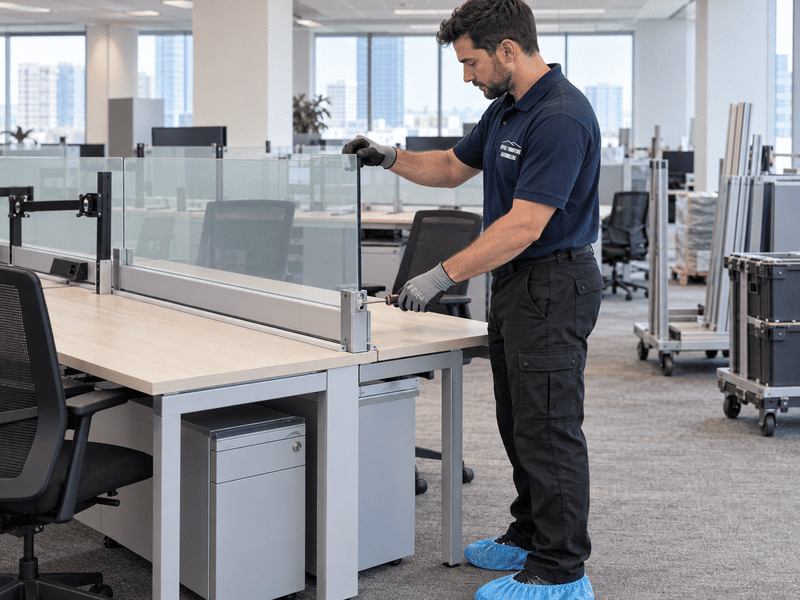
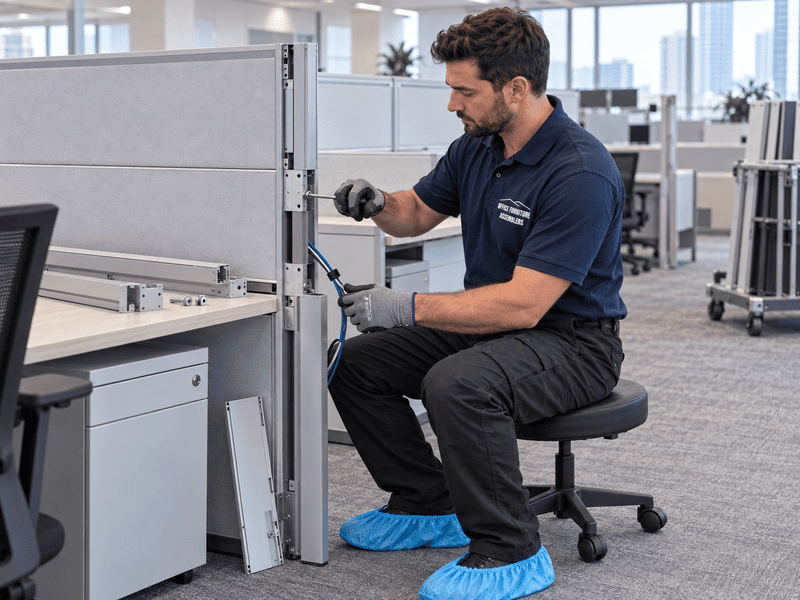
Modular cubicles and workstations require careful documentation, controlled disassembly, labeled hardware, and accurate reinstallation. Without a system, parts get lost and panels misalign.
High-density open office systems, panel-managed workstations, privacy partition screens, integrated desk matrices, and workstation storage components all share one trait. They come apart in dozens of pieces. Every bracket, connector, and panel has a correct position.
Common risks during improper breakdown include:
- Missing hardware and unlabeled frame components
- Misaligned panels that no longer fit together
- Damaged work surfaces and trimmed edges
- Costly reinstallation delays that affect employee schedules
Teams that specialize in technical office furniture disassembly support map each system before teardown. They photograph configurations, bag hardware by workstation, and label every panel.
This matters even more when IT equipment is involved. A crew focused on keeping office equipment parts and cables organized prevents the Monday-morning scramble that frustrates employees. Smaller workplaces benefit too, since office cubicle installation for smaller workplaces follows the same documentation discipline.
Large Conference Furniture Requires Technical Handling
Large conference tables and executive furniture need specialized handling because of their weight, dimensions, multi-piece construction, and delicate surfaces. Many also integrate power and video technology.
Weight and Multi-Piece Construction
Massive modular conference tables rarely fit through standard doorways fully assembled. Heavy timber executive desks and stone-top meeting tables often require partial disassembly before they leave the room. Expanding tables may also need precision micro-leveling when rebuilt.
Technology Integration
Dynamic V-shaped video-conferencing tables house cable channels, power modules, and AV connections. Technicians must disconnect and protect these components in sequence. For related guidance, many facility teams also review tips on safely moving computers and office electronics before a move begins.
A headquarters relocation in downtown Washington, DC illustrates this well. The boardroom table comes apart first, moves on a protected schedule, and gets rebuilt before executive meetings resume.
Heavy Storage Assets Need Controlled Relocation
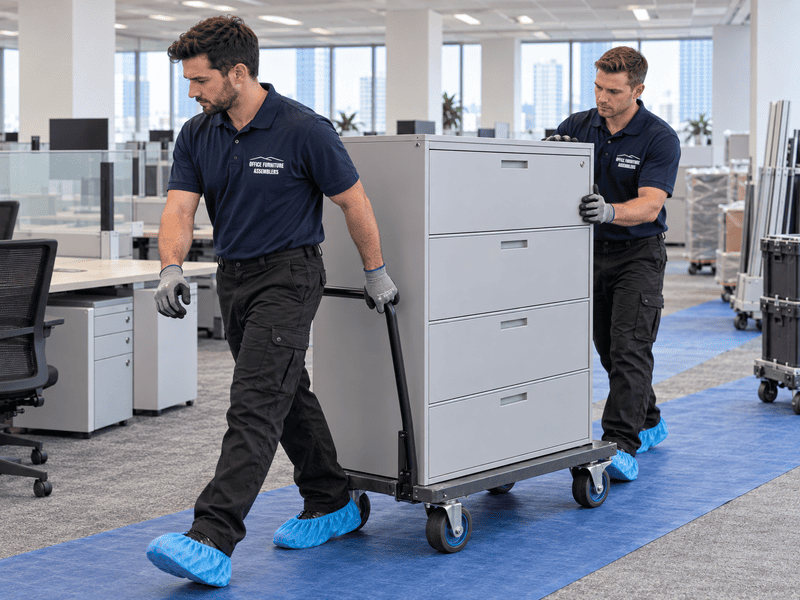
Heavy filing systems require careful planning, controlled movement, drawer management, and appropriate reinstallation. Weight distribution, floor conditions, and access paths all shape the plan.
Consider these common commercial storage assets:
| Asset Type | Primary Handling Concern | Relocation Approach |
|---|---|---|
| Heavy-duty lateral filing cabinets | Loaded weight and drawer shift | Empty, secure, and move upright |
| Rolling mobile high-density stacks | Track alignment and floor load | Inspect tracks before repositioning |
| Modular supply lockers | Anti-tip anchoring points | Anchor after placement is confirmed |
| Large storage credenzas | Surface protection | Pad, wrap, and stage by department |
| Document archive systems | Sequence and access paths | Label sections for ordered rebuild |
Anti-tip mechanisms deserve attention during reinstallation, though final anchoring decisions depend on site conditions and building requirements. Crews using specialized tools for heavy furniture handling move these assets with more control and less strain. For a corporate consolidation in suburban Maryland, this approach helps keep records departments functional between phases.
Every Office Asset Needs a Clear Relocation Plan
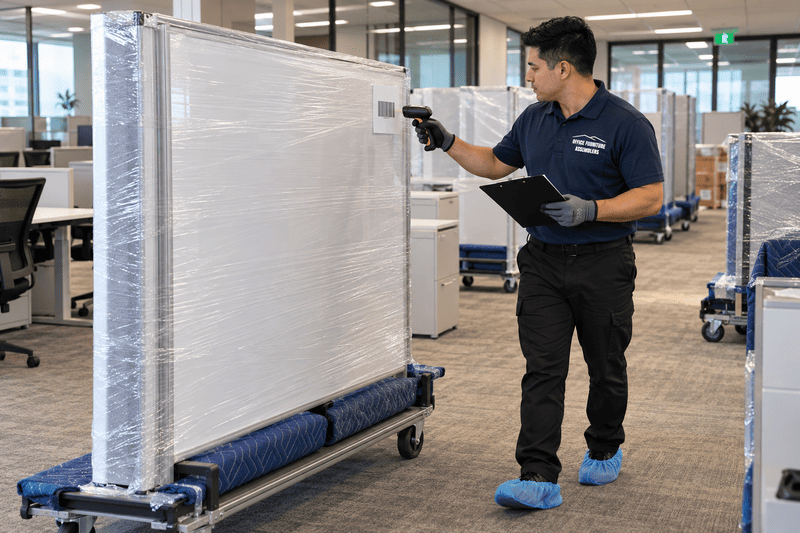
Complex office relocation means planning, disassembling, transporting, reconfiguring, and reinstalling commercial furniture and workplace assets. That plan must account for building access, employee schedules, equipment requirements, and daily operations.
A workplace strategist coordinating moving office furniture between building floors faces different constraints than one managing a cross-state expansion. Both, however, need the same planning inputs.
Key factors to confirm before teardown begins:
- Elevator reservations, loading dock windows, and corridor dimensions
- Employee schedules and staggered department move dates
- Technology disconnection and reconnection sequences
- Floor load considerations for high-density filing
- Staging areas for labeled panels and hardware
Packaging also plays a role. Reviewing U.S. packaging material requirements information helps procurement teams choose appropriate protective materials for surfaces, glass, and stone.
Reinstallation Matters as Much as Disassembly
Reinstallation should be planned before disassembly begins. Leveling, anchoring, and reconfiguration decisions made early prevent rework later.
A leased office in Northern Virginia rarely matches the old floor plan exactly. Panel runs shift, storage credenzas change walls, and reception seating clusters get reconfigured. Teams providing commercial office furniture assembly services rebuild systems to match the new layout, not just the old one.
Budget planning matters too. Decision-makers comparing office furniture installation costs across regional markets can align relocation scope with realistic project timelines.
Phased Moves Can Help Keep Departments Working
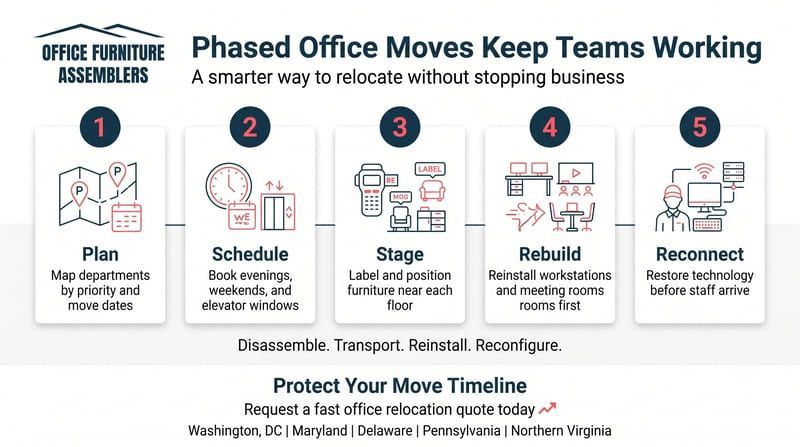
Phased relocation supports business continuity by moving departments on staggered schedules. It cannot guarantee uninterrupted operations, but it can help reduce disruption.
A renovation in a multi-floor Philadelphia building offers a practical example. While one floor gets rebuilt, staff temporarily occupy another. Workstation reconfiguration happens in waves, and conference rooms get rebuilt after each phase.
A workable phased approach often includes:
- Sequencing departments by operational priority
- Scheduling teardown and rebuilds during evenings or weekends
- Staging furniture near the destination floor before installation
- Rebuilding meeting spaces early in each phase
- Confirming technology reconnection before staff arrive
Final scheduling always depends on site conditions, building access, and project scope.
Internal Teams Should Not Have to Handle Everything
Most businesses cannot dedicate employees to technical furniture teardown. Outsourcing may free internal staff for higher-priority coordination tasks.
Office employees lack the tools, documentation habits, and hardware familiarity that modular systems demand. Asking them to reverse-engineer cubicle frames risks injury, damaged assets, and extended timelines. Many property managers therefore pair furniture specialists with professional commercial moving support for general freight.
Procurement executives should also understand liability basics. The FMCSA publishes useful consumer moving liability protection information that helps teams structure vendor agreements responsibly.
Professional Relocation Support Reduces Logistical Friction
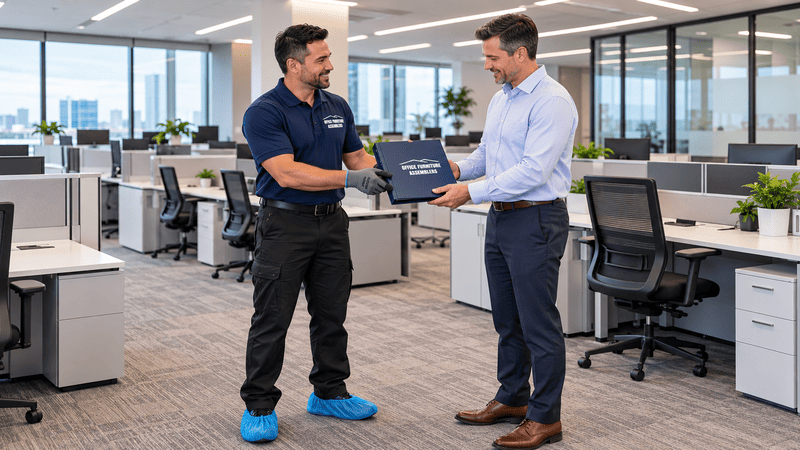
Outsourced relocation teams help facility managers manage complex furniture transitions. They bring structure to disassembly, staging, transport, and reinstallation.
The benefits are practical and operational:
- Reduced internal labor demands on facility staff
- Organized components, labeled hardware, and documented systems
- Controlled handling of oversized and sensitive office assets
- Storage and staging support for high-volume projects
- Off-peak scheduling that works around business hours
- More accurate reinstallation and workspace reconfiguration
Office Furniture Assemblers arrives fully licensed and insured, equipped to support complex corporate transitions. The team's capabilities include commercial property protection practices, technical furniture disassembly, reverse engineering modular frames, precision micro-leveling of expanding tables, secure handling of heavy filing systems, anti-tip anchoring considerations, high-volume project staging, flexible off-peak scheduling, organized asset handling, and complete reinstallation and workspace reconfiguration.
Partnering with specialists in professional office furniture moving support can improve relocation coordination from planning through final placement. Teams planning hybrid workplace updates can also draw on professional furniture assembly for workspaces for satellite and remote-office setups.
Request Professional Office Relocation Support Today
Reducing relocation complexity starts with organizing furniture disassembly, protecting office assets, and preparing your workspace for professional reinstallation. Office Furniture Assemblers brings the technical crews and project structure that complex moves demand.
Our network also supports adjacent needs, from specialized equipment repair to large basketball goal installation, through the same commitment to organized, technical work.
Safeguard Your Operational Timeline Before Move Day
Corporate facility managers, office operations directors, and enterprise procurement executives across Washington, DC, Maryland, Delaware, Pennsylvania, and Northern Virginia can request an office relocation consultation today for a fast quote or an on-site asset assembly consultation.
FREQUENTLY ASKED QUESTIONS
Why should companies outsource complex office relocation work?
Modular systems, heavy assets, and multi-room schedules require technical skills most internal teams lack. Outsourcing helps reduce disruption and frees staff for project coordination.
What furniture usually requires professional disassembly?
Modular cubicles, panel workstations, large conference tables, executive desks, high-density filing systems, and wall-mounted media boards typically need technical teardown.
Can modular cubicles be moved and reinstalled?
Yes. With documented breakdown, labeled hardware, and organized components, modular systems can be transported and accurately rebuilt in the new layout.
How are large conference tables relocated?
Most require partial disassembly, protected transport, and careful reassembly. Expanding tables may also need precision micro-leveling after reinstallation.
Can office furniture be moved between floors?
Yes. Floor-to-floor moves require elevator reservations, corridor measurements, and staged scheduling rather than full transport logistics.
Should furniture be disassembled before an office move?
Often yes. Large, heavy, or modular pieces move more safely and fit through access points when dismantled in a controlled sequence.
How can businesses reduce disruption during relocation?
Phased schedules, evening and weekend work, early conference room rebuilds, and organized staging can all help limit unnecessary downtime.
When should a facility manager request an office relocation quote?
As soon as a relocation, renovation, or consolidation is confirmed. Early planning improves scheduling flexibility and supports accurate project scoping.